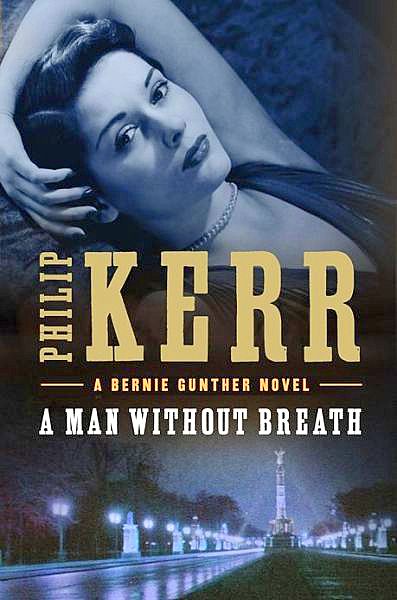
A Review of A
MAN WITHOUT BREATH by Philip Kerr
A
new Bernie Gunther novel is always a noteworthy event for Berlin Noir fans and A MAN WITHOUT BREATH marks the first
new release in the short lifespan of this blog. So without further ado, let's
see how the ninth Gunther novel measures up.
The
year is 1943 and the Nazis are trying to pick up the pieces after the surrender
at Stalingrad. This devastating event sets the tone for the novel. Gunther
novels have been cynical in the past, but A
MAN WITHOUT BREATH takes it to new levels. And rightly so as, at the point
the tale kicks off, only the most fanatical Nazi still believes Germany will
somehow prevail and win the war. Fatalism has replaced optimism and Gunther has
some company in his misery.
The
novel opens with Gunther in Berlin, working for the Wehrmacht War Crimes Bureau
and the irony of this entity should not be lost on the reader. Gunther has been
working with a witness to a war crime involving the British Navy's sinking of a
German hospital ship. The witness is a Jew but the Nazis are prepared to
overlook that for the moment so long as good propaganda against their enemies
will result from the investigation. It is while in this capacity that Gunther
has his world yanked out from under him, literally. An RAF bomb strike on the
building he's in collapses the structure around him and this is the metaphor
for the entire novel. Germany has had the rug of Hitler's invincibility yanked
out from under it with the recent defeat and Gunther's near-death in the rubble
echoes this while foreshadowing what is coming for the country in the next
couple of years.
Still
reeling, Gunther is given the task of investigating a massacre of Polish
officers by the Soviets in the Katyn forest near Smolensk. If true, the Nazis
hope to have a strong propaganda tool to combat the Allies' claims of such
atrocities being committed in the name of the German people. Given the task of
handling the matter by Goebbels himself, Gunther reluctantly heads to Smolensk
to continue the investigation.
That
is the basic set up of the novel and the rest of the action plays out in and
around the forest for the most part. As always, Kerr provides encyclopedic
local details and the cast of characters he surrounds Gunther with are
well-rounded characters. Even the monsters have shades to them. The plot twists
and turns nicely as the investigation is soon complicated by multiple murders
and as many suspects all while Gunther stumbles into the budding assassination
attempts being plotted to remove Hitler. The suspects are many, the answer few
as Gunther balances getting Goebbels want he wants while wrestling with the
hopelessness and insanity of the situation where the mass grave the Soviets
created through wholesale slaughter is probed while the nearby ones the SS
themselves filled with murdered civilians are ignored - all while it's only a
matter of time before the Russian counter-offensive drives the Germans out of
the area for good and all. It's a rich tapestry Kerr gives us and combined with
the engaging mysteries makes for riveting reading.
 Threatened
at every turn, Gunther must walk a razor's edge as he has done in his past work
for the Nazis but this time he goes over that edge in a defining moment for the
character that will forever change your perception of the man. His motivations
for doing so should be a matter of great debate amongst Berlin Noir fans.
Threatened
at every turn, Gunther must walk a razor's edge as he has done in his past work
for the Nazis but this time he goes over that edge in a defining moment for the
character that will forever change your perception of the man. His motivations
for doing so should be a matter of great debate amongst Berlin Noir fans.
The
novel is quick paced, interesting at every turn of the plot and steeped in
period details. The result is one of the best entries into the series.
The
sole misstep that slightly soured the reading experience is the romantic plot
shoe-horned into the narrative. As a long-time hardboiled mystery fan/writer
myself, I'm well aware that a romantic interest is one of the tropes of the
genre. Gunther has had many in the past, usually with disastrous results, but
they have fit the tales and their pre-war, war and post-war settings. But the
romantic entanglement in BREATH comes across as too forced, present as a
'necessary' aspect of the genre rather than an integral part of the story. When
the beautiful scientist showed up to exchange quips with Gunther before hopping
into bed, I rolled my eyes and groaned. The rich plotlines of the novel were
hampered by the prerequisite love interest this time out and I breathed a sigh
of relief when this subplot was dispensed with.
This
one aspect of A MAN WITHOUT BREATH
should not deter Gunther or Berlin Noir fans from reading the novel. There is
enough intrigue and moral complexity tinged with impending doom to satisfy any
discerning reader of historical mystery. Kerr still leads the Berlin Noir field
by a long margin and his strengths as a novelist and storyteller are showcased
here. Sure to spur some debate amongst readers, A MAN WITHOUT BREATH will leave you breathless. Don't miss it.
 As
Berlin Noir fans, and readers of this blog well know, there are many authors
who have chosen to play in Philip Kerr's Berlin sandbox, but few do it as well
as Jonathan Rabb. SHADOW AND LIGHT
was my first Rabb novel and is the second (to date) featuring Kriminal-Oberkommissar Nikolai
Hoffner. It will not be my last.
As
Berlin Noir fans, and readers of this blog well know, there are many authors
who have chosen to play in Philip Kerr's Berlin sandbox, but few do it as well
as Jonathan Rabb. SHADOW AND LIGHT
was my first Rabb novel and is the second (to date) featuring Kriminal-Oberkommissar Nikolai
Hoffner. It will not be my last.
 SHADOW AND LIGHT is a
captivating read. It does everything it sets out to do and does it very well. Plots
and sub-plots abound. The action is sparse but riveting. Hoffner, and his
sons... well, this isn't an episode of My Three Sons and their relationship is
painfully depicted, warts and all, as Hoffner tries to balance his personal and
professional lives.
SHADOW AND LIGHT is a
captivating read. It does everything it sets out to do and does it very well. Plots
and sub-plots abound. The action is sparse but riveting. Hoffner, and his
sons... well, this isn't an episode of My Three Sons and their relationship is
painfully depicted, warts and all, as Hoffner tries to balance his personal and
professional lives.
 As
Berlin Noir fans, and readers of this blog well know, there are many authors
who have chosen to play in Philip Kerr's Berlin sandbox, but few do it as well
as Jonathan Rabb. SHADOW AND LIGHT
was my first Rabb novel and is the second (to date) featuring Kriminal-Oberkommissar Nikolai
Hoffner. It will not be my last.
As
Berlin Noir fans, and readers of this blog well know, there are many authors
who have chosen to play in Philip Kerr's Berlin sandbox, but few do it as well
as Jonathan Rabb. SHADOW AND LIGHT
was my first Rabb novel and is the second (to date) featuring Kriminal-Oberkommissar Nikolai
Hoffner. It will not be my last. SHADOW AND LIGHT is a
captivating read. It does everything it sets out to do and does it very well. Plots
and sub-plots abound. The action is sparse but riveting. Hoffner, and his
sons... well, this isn't an episode of My Three Sons and their relationship is
painfully depicted, warts and all, as Hoffner tries to balance his personal and
professional lives.
SHADOW AND LIGHT is a
captivating read. It does everything it sets out to do and does it very well. Plots
and sub-plots abound. The action is sparse but riveting. Hoffner, and his
sons... well, this isn't an episode of My Three Sons and their relationship is
painfully depicted, warts and all, as Hoffner tries to balance his personal and
professional lives.